

Here is a guide outlining critical dimensions to evaluate when choosing an rPET pellets (pet pellets) manufacturer, with a focus on compliance, quality, and technical capability.
-
Regulatory Approvals and Certifications: The Foundation of Trust
Food-Contact Safety Certifications
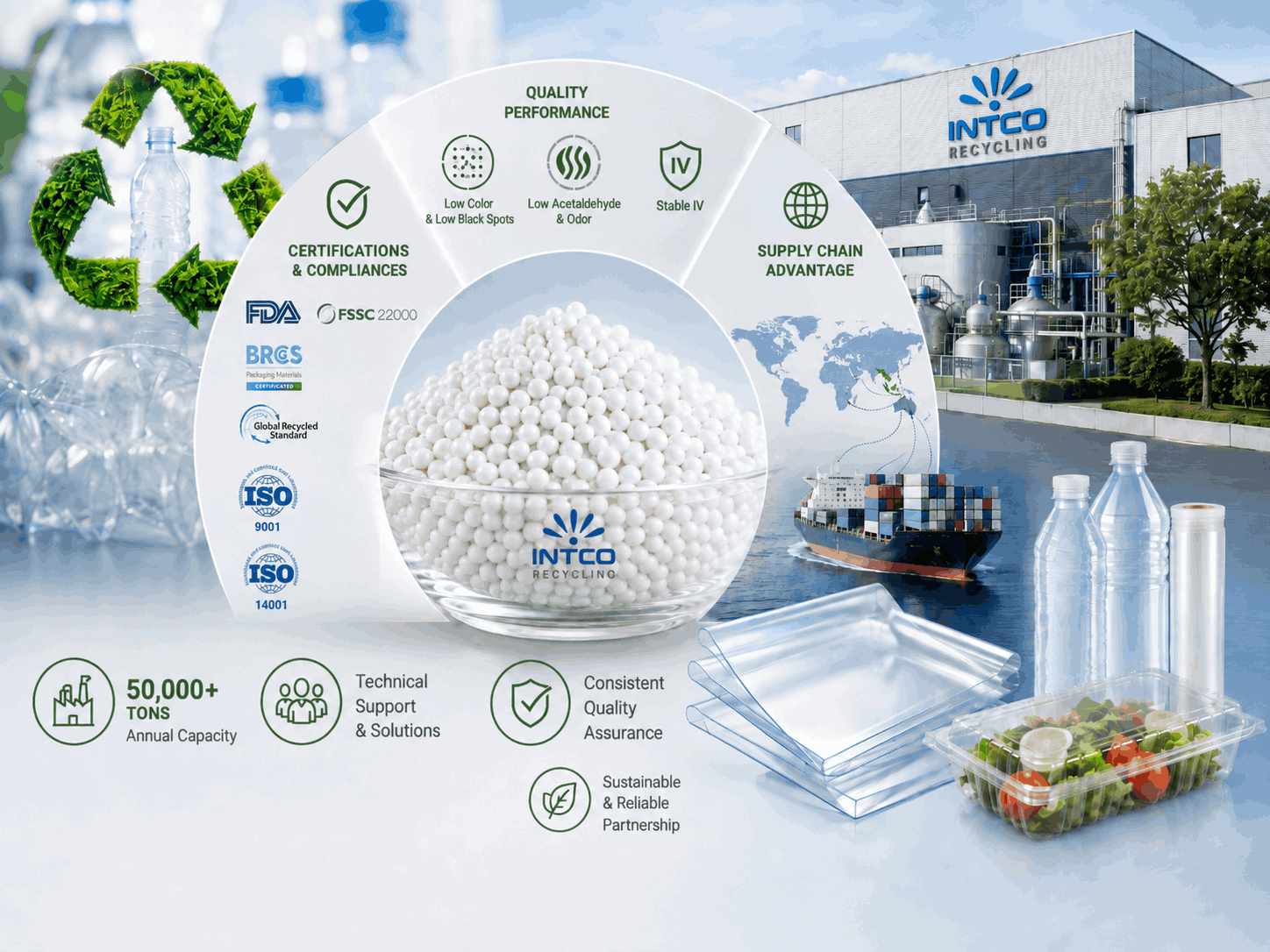
If your final products involve food-grade rpet packaging or beverage containers, ensure the manufacturer holds key food safety approvals. These represent the highest standard of purity and process control:- US FDA Letter of No Objection (NOL)
- FSSC 22000 (Food Safety System Certification)
- BRC Global Standard (British Retail Consortium) for Packaging Materials
Traceability and Environmental Standards
To validate sustainability claims and appeal to eco-conscious consumers, verify environmental and traceability certifications:- GRS (Global Recycled Standard): Guarantees legitimate post-consumer recycled (PCR) origins and ensures reliable supply chain transparency.
- ISO 14001: Demonstrates a recognized Environmental Management System.
Chemical Compliance and Quality Management
Ensure the input material is safe and the production process is consistent:- ISO 9001: Confirms a robust Quality Management System is in place.
-
Tariff Structures, Logistics, and Supply Chain Resilience
- Strategic Tariff Advantages: Factories operating out of primary trade logistics hubs, such as Malaysia, offer competitive tariff rates when exporting to North America, Europe, and RCEP member states. This effectively bypasses high anti-dumping duties imposed on rPET from certain other regions.
- Logistics Efficiency: Proximity to major international deep-water ports provides better container availability, flexible shipping routes, and protection against supply chain bottlenecks that could delay downstream production.
-
Product Quality and Physical Performance Metrics
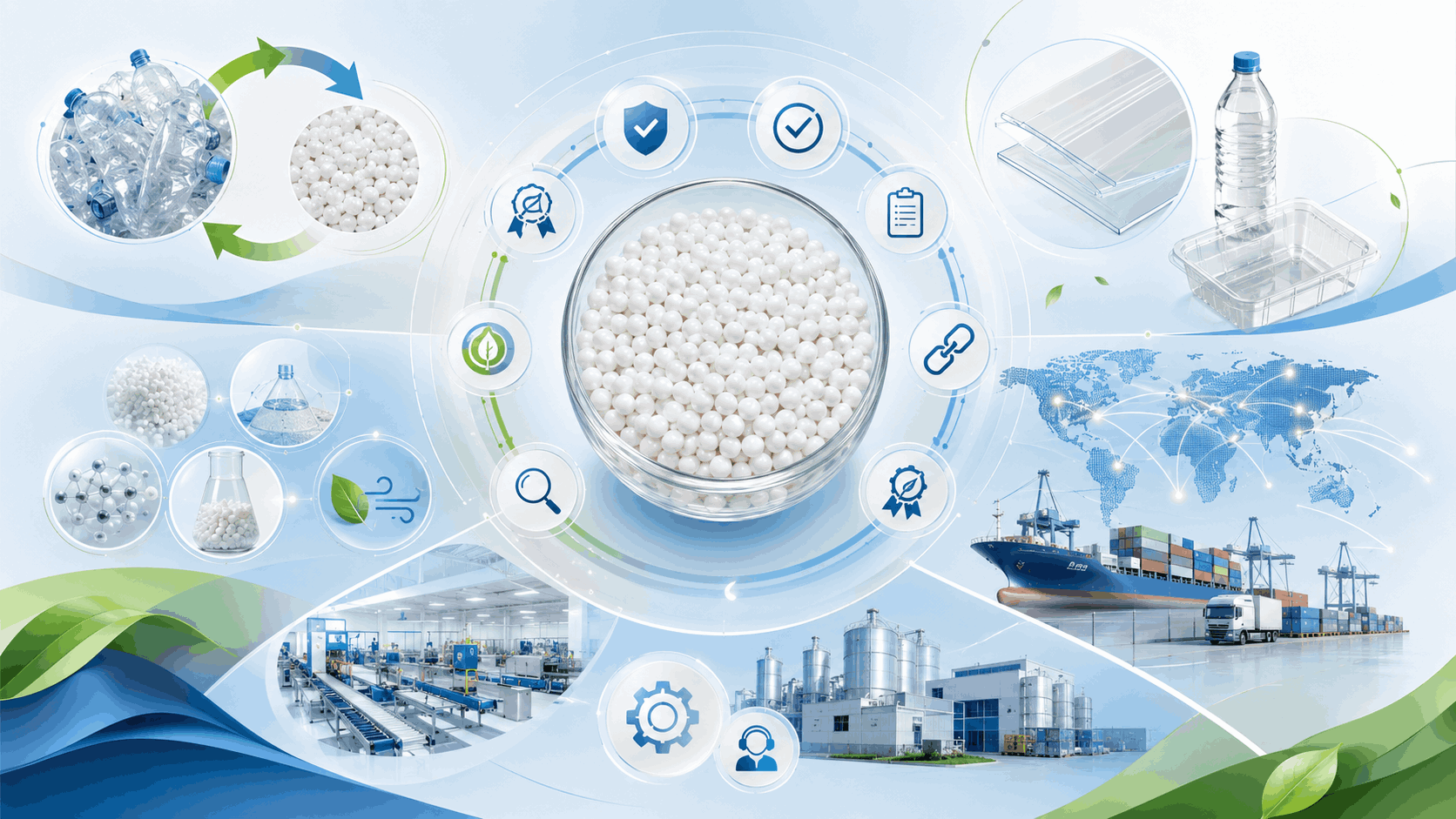
- Color and Contamination Control: Look for advanced optical sorting and fine melt filtration (e.g., 50–80 micron filtration) to ensure low $$b^$$ values ($$L^*a^*b^$$ color scale) and minimal black spots. This preserves high transparency in clear packaging applications.
- Acetaldehyde (AA) and Odor Removal: Food-grade pellets require thorough deep-degassing and Solid State Polymerization (SSP) to keep AA levels strictly below safety limits.
- IV Consistency: Ensure the factory provides consistent Intrinsic Viscosity (IV) grades suitable for sheet extrusion.
-
Production Capacity and Technical Support
- Capacity Scale: Prioritize manufacturers with an annual capacity exceeding 50,000 tons. Large-scale manufacturing indicates robust raw bottle-flake sourcing networks and continuous, stable production lines.
- End-to-End Technical Guidance: Dedicated technical teams can assist downstream processors—like sheet manufacturers—in resolving processing challenges such as thermal degradation or IV drop during extrusion.
Conclusion
As a global leader in sustainable plastics, INTCO RECYCLING operates a state-of-the-art manufacturing facility in Malaysia with an annual rPET pellet capacity of 50,000 tons.Our commitment to quality and safety is backed by a complete certification portfolio, including FDA NOL, FSSC 22000, BRC, GRS, ISO 9001, and ISO 14001. We supply premium food-grade and high-purity pet pellets designed for pet sheets manufacturers, rpet packaging, and high-end pet recycled products. Leveraging strategic tariff advantages, strict quality control, and dedicated technical teams, INTCO RECYCLING empowers global businesses with reliable, sustainable, and compliant material solutions.